

 |


|

|
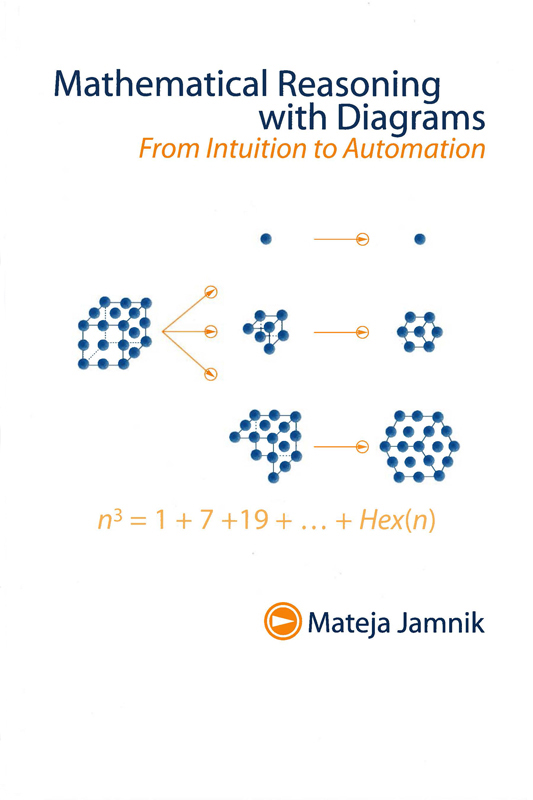
Mathematical Reasoning with DiagramsTheorems in automated theorem proving are usually proved by formal logical proofs. However, there is a subset of problems which humans can prove by the use of geometric operations on diagrams, so called diagrammatic proofs. This book investigates and describes how such diagrammatic reasoning about mathematical theorems can be automated. Concrete, rather than general diagrams are used to prove particular instances of a universal statement. The “inference steps” of a diagrammatic proof are formulated in terms of geometric operations on the diagram. A general schematic proof of the universal statement is induced from these proof instances by means of the constructive omega-rule. Schematic proofs are represented as recursive programs which, given a particular diagram, return the proof for that diagram. It is necessary to reason about this recursive program to show that it outputs a correct proof. One method of confirming that the abstraction of the schematic proof from the proof instances is sound is proving the correctness of schematic proofs in the meta-theory of diagrams. The book presents an investigation of these ideas and their implementation in the system, called Diamond. is a research fellow in the School of Computer Science at The University of Birmingham in the United Kingdom. Read an excerpt from this book. Contents
11/30/2001 ISBN (Paperback): 1575863243 (9781575863245)
Subject: Mathematics--Charts and diagrams; Logic; Automatic theorem proving
|


 Distributed by the
University of Chicago Press |
|
pubs @ csli.stanford.edu
|
CSLI Publications
Stanford University Cordura Hall 210 Panama Street Stanford, CA 94305-4101 (650) 723-1839 |