

 |


|

|
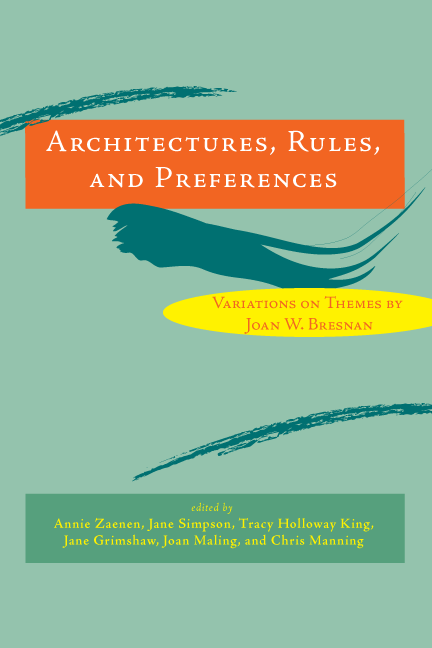
Architectures, Rules, and PreferencesVariations on Themes by Joan W. Bresnan Architectures, Rules, and Preferences reflects the interests and honors the influence of Joan W. Bresnan's two decades of foundational work on Lexical-Functional Grammar. This comprehensive volume includes contributions by leading linguists on language typology, synchronic variation, language change, constituent structure, function identification, subject condition, control, complex predicates, NP internal structure, wh-constructions, syntactic features, and lexical issues. Featuring an impressive range of empirical and theoretical research, this collection covers more than a dozen spoken languages as well as American Sign Language. Language typology and synchronic variation are addressed by Borjars, Nordlinger, Sadler, Seiler, and Vincent. Language change is discussed by Allen, Borjars, Butt, Ishikawa, and Vincent. Several papers explore specific syntactic problems of constituent structure, including NP internal structure (Allen, Yehuda Falk, Fassi Fehri, Grimshaw, Seiler, and Vinet), function identification (Berman), the subject condition (Alsina), control (Asudeh and Toivonen), complex predicates (Ishikawa), traceless accounts of wh-constructions (Dalrymple, Kaplan, and King) and syntactic features (Alvarez, Borjars, Frederking, Good, Levin, and Vincent). Lexical issues are explored by Kroeger, Levin, Peterson, and Rappoport Hovav. Extensions of the parallel architecture of LFG to information structure find an expression in work by Butt, Mchombo, Neidle, and Simpson. Work in LFG incorporating insights from Optimality Theory (OT) is found in Cho, Choi, Lee and Siaki, whereas Andrews shows how to develop an OT-LFG with semantic interpretation. Jaeger and Maslova consider the foundations of stochastic OT. is Principal Scientist at the Palo Alto Research Center and consulting professor at Stanford University. Contents
December 2007 ISBN (Paperback): 1575865602 (9781575865607)
|


 Distributed by the
University of Chicago Press |
|
pubs @ csli.stanford.edu
|
CSLI Publications
Stanford University Cordura Hall 210 Panama Street Stanford, CA 94305-4101 (650) 723-1839 |